ON THE BLOG
Under Special Protection
As an administrative assistant for small businesses and nonprofit organizations, I often find myself writing—whether it’s for websites, newsletters, or grant applications. And I love it. There’s something deeply fulfilling about putting words together to share stories, inspire action, and help organizations thrive.
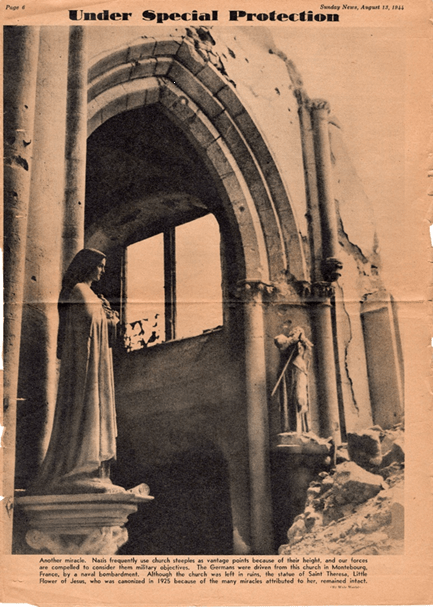
A while back, I wrote a newsletter article. It was about a remarkable piece of history—a donated newspaper clipping from World War II.
The clipping showed a photograph of a church that had been destroyed by the Nazis. In the devastation, one thing stood untouched: a beautiful statue of St. Therese. She stood tall, undisturbed, a symbol of resilience and faith in the face of destruction.
This story struck a chord with me. Many years ago, I taught Kindergarten at St. Therese, and during that time, I learned a lot about the saint. One of the things I loved most was her simple yet profound motto: “Do little things with great love.” It’s a philosophy that has stuck with me over the years because it feels so accessible. It reminds me that small acts of kindness, care, and dedication can have a lasting impact.
That belief carries over into the work I do today. I help nonprofits secure funding. I craft compelling newsletters. I manage administrative tasks so a small business can focus on its mission. I strive to do even the smallest tasks with great love.
Saint Therese gives me hope that we can all be saints in our own little ways.
Not by doing grand gestures but rather focusing on little things —done with great care—that make all the difference.
Flight Expo Inc Newsletter, March 2024
“World War II, which lasted from 1939 to 1945, was a global conflict involving most of the world’s nations. It was the deadliest and most widespread war in history, resulting in millions of casualties, immense destruction, and significant political and social upheaval.
During World War II, especially in occupied areas such as France, there were instances where Nazi forces seized control of churches for various reasons, including using them as military bases or storage facilities. Montebourg, like many other towns in France, experienced German occupation during the war. The occupation of churches by Nazi forces was part of their broader strategy to assert control over occupied territories.
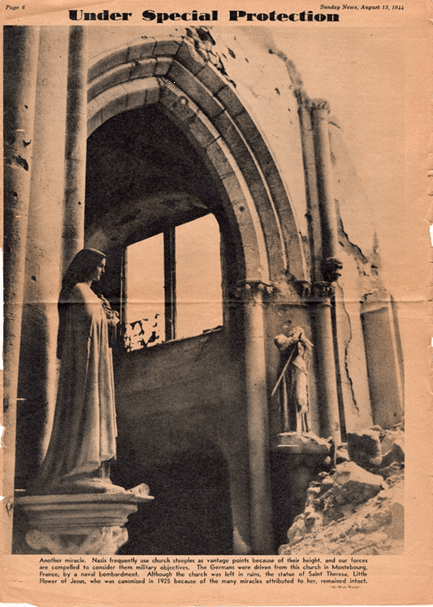
Through all the destruction, there were still miracles to be found.
Following a naval bombardment from the Allied forces, Nazis were driven out of a medieval church dating back to the 15th century. Left among the ruins was a statue of St. Therese of Lisieux, also known as “The Little Flower.” Therese was a French Catholic nun who lived in the 19th century. She entered the Carmelite convent in Lisieux at the age of 15. Therese is renowned for her spiritual autobiography, “Story of a Soul,” which she published after her death. In this autobiography, she described her “Little Way,” which emphasized simplicity, humility, and devotion to God in everyday life. Therese advocated for performing small acts of love and kindness with great love, believing these simple gestures could lead to holiness. Despite her short life – she died at age 24 from tuberculosis – she was canonized as a saint in 1925 and remains one of the most influential saints in the Catholic tradition.
When the Nazis fled the church in Montebourg back in 1925, the statue of St. Therese stood; undisturbed, looking out over the vast destruction, silently holding onto the faith that she exuded, performing one more small act of love to show us all the way.”

Discover more from Highline Virtual LLC
Subscribe to get the latest posts sent to your email.
 Highline Virtual LLC